-
June 8th, 2008, 05:36 AM
#31
Senior Hostboard Member


Just like to add my support to the PCB warning. Also agree about the listener adjusting to a change in sound. Humans are designed to adapt to variations in their evironment. It's called tolerance. Marketers use this to advantage in their sales psychology.
Marshall.
-
June 8th, 2008, 06:21 AM
#32
Inactive Member

Originally posted by Earl K:
- I have ( & use ) a bunch of Mallory motor run caps . They're the newer MPP type ( metalized polypropylene swimming in oil )...
<font size="2" face="Verdana, Helvetica, sans-serif">A good reminder that all that swims in oil is not paper. There are probably a few users extolling the virtues of their PIOs that aren't aware it's metalized poly they're so pleased with... 
-
June 8th, 2008, 09:37 AM
#33
Senior Hostboard Member
I've got a few large 'in oil' caps that are marked: CORNELL-DUBILIER, SOGGY FOIL, NO PCB, 15 MFD 525V AC 60 HZ, MADE IN THE U.S.A.
A bit large for guitar amp power supply. Are they good for any thing else?
Marshall.
-
June 8th, 2008, 07:10 PM
#34
Senior Hostboard Member

Brad,
- After further investigation, I'm confident stating that what you displayed is a "dry" paper cap . The 2 paper layers are "waxed" .
- At one time, Sprague sold a model of this sort / as well as a metalizzed paper type .
- I found & unravelled the old ( pictured ) core .
- ( IMHO ), there's no way it's a dry NP electrolytic .
- The reasons ?
(a) I don't think that there are enough elemental layers in it's construction ( there are only 4 versus the 6 that I think are needed ).
(b) There's no evidence of any oxide layer on any of the foil layers ( cathode or anode ).
(c) And finally, both paper layers are lacking the necessary electrolytic "paste" that needs be present ( gooped onto the paper layer that faces the metallic oxide layer ) .
- I have new pics ( showing the revealed layers ) but can no longer upload attachements over at LHF due to my ancient computer .
- Until I obtain a "Callins" labelled specimen of sufficient size, I won't ever know if the ones used by Altec share the same construction approach.
<. Earl K
<font color="#FFFFFF" size="1">[ June 08, 2008 04:13 PM: Message edited by: Earl K ]</font>
-
June 8th, 2008, 07:20 PM
#35
Senior Hostboard Member
Marshall,
You can use your 15uF caps, either within a passive crossover ( if those values fit the design ) or you can double them up ( connected in parallel to each other ) and use them as DC blocking caps if / when you biamp any compresson drivers ( the twinned pair of caps are then connected in series to the driver / interrupting the hot leg going to the compression driver ) .
<. earl K
<font color="#FFFFFF" size="1">[ June 08, 2008 04:34 PM: Message edited by: Earl K ]</font>
-
June 8th, 2008, 09:36 PM
#36
Inactive Member
Originally posted by Earl K:
- ( IMHO ), there's no way it's a dry NP electrolytic...
<font size="2" face="Verdana, Helvetica, sans-serif">Thanks a lot Earl! I've been looking for an example to autopsy, but that can be the needle/haystack thing here. I did find the same callins cap, but haven't opened it yet, as you inferred, you'd almost need a microscope (I certainly would).
The lack of oxide is the kicker IMO, and exactly what I'd have looked for. No oxidation, no electrolytic. Consider too that independant film layers can run from 0.5 to 50 um thickness, so not necessarily too obvious.
Beyond the visual clues though, even milspec 'lytics could never be expected to last this long or have a modicum of acceptable tolerance, particularly in a lv app that will never see the potentials needed to maintain the oxide layer. If I ever believed Altec engineers would have allowed something like that, I'd be selling a lot of stuff in a hurry, and looking for a new 'religion'...
Lots of tinkering/repair/rebuilding old gear has led to automatic habits for me. Replace all old 'lytics...don't even think twice, just do it before you power up and smoke something. The rest? Test a little to satisfy your curiousity, then usually just button it up.
Thanks again my friend, I always enjoy our disscussions and benefit from your input. This time, it was a reminder to never say never.
<font color="#FFFFFF" size="1">[ June 08, 2008 07:18 PM: Message edited by: bfish ]</font>
-
June 8th, 2008, 09:43 PM
#37
Inactive Member
-
June 8th, 2008, 10:39 PM
#38
Inactive Member

Hi Earl and Bfish
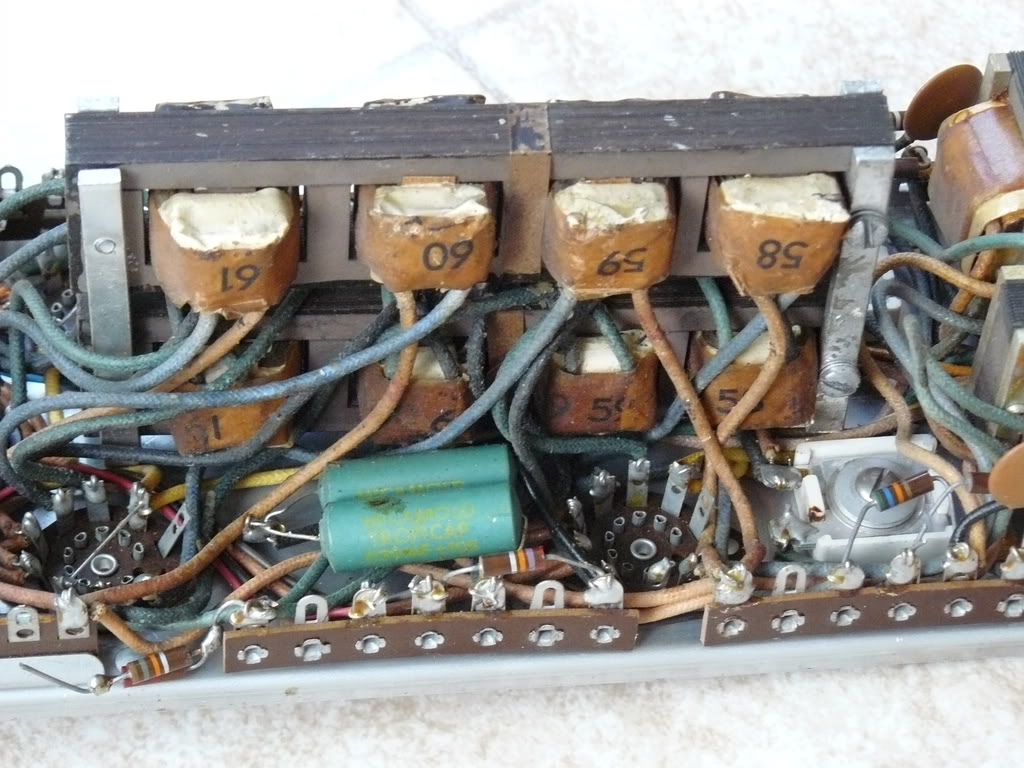
What are tropicaps? They are two green capacitors in the bottom left of the picture. I've never seen these before. I am assuming that these are tone caps or coupling caps? They are from an old dead organ. Further, what are those transformer looking stuffs?
Thanks.
Tim
<font color="#FFFFFF" size="1">[ June 08, 2008 07:44 PM: Message edited by: timp ]</font>
-
June 8th, 2008, 11:16 PM
#39
Inactive Member
Tropicap was a Micamold trade name. Your pictured examples are just another good quality film cap from days gone by. Yes, they're often found in coupling and filter (tone) apps. Don't know Baldwins well enough to say what purpose the xfmrs were for.
Sell the Tropicaps on eBay. Some believer in cap magic will pay enough to fund your next XO project.
-
June 8th, 2008, 11:33 PM
#40
Inactive Member
 Posting Permissions
- You may not post new threads
- You may not post replies
- You may not post attachments
- You may not edit your posts
-
Forum Rules
This forum has been viewed: 28131802 times.



Bookmarks